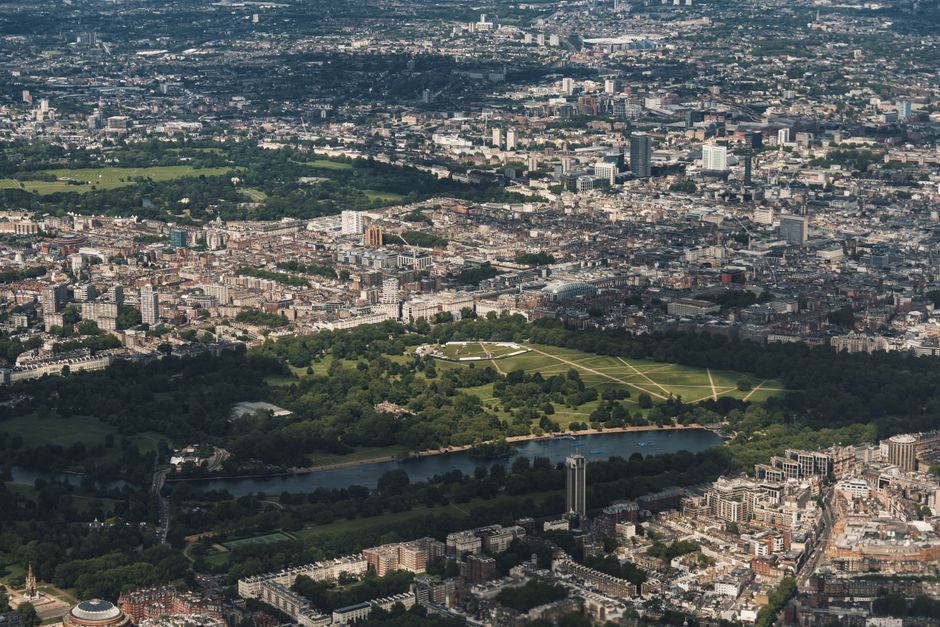
London's Geospatial Commission and the Greater London Authority are quietly running one of Europe's most ambitious programmes to scrub duplicate and conflicting imagery from the city's public digital infrastructure — a problem that has grown sharply as street-level mapping, planning portals and emergency services all rely on the same underlying datasets. The GLA's Digital Twin project, centred on a live 3D model of the capital updated continuously with data from sources including Ordnance Survey and Transport for London's own camera networks, now covers all 32 boroughs plus the City of London, a milestone reached in early 2026.
Why does this matter right now? The Labour government's planning reform agenda has pushed local councils to digitise their development pipelines faster than at any point in the last decade. When duplicate images — the same building captured twice, or an image of a demolished structure still sitting in a live dataset — creep into planning portals, the consequences range from embarrassing to genuinely costly. A single erroneous image flagged during a planning review in Southwark last year caused a six-week delay to a residential scheme on the Old Kent Road, according to borough planning documentation published in March 2026.
How London Compares
Amsterdam has taken a different tack. The Dutch capital's City Data team, operating out of the municipality's digital infrastructure department on Weesperstraat, runs an automated deduplication pipeline that cross-references imagery against its 3D BAG building register every 90 days. The cycle is faster than London's current six-month refresh cadence for non-priority zones, though the GLA argues its AI-assisted flagging system catches errors between full refreshes. Singapore's Urban Redevelopment Authority runs a near-real-time system, but the city-state's physical scale — 733 square kilometres against Greater London's 1,572 — makes direct comparison difficult.
New York City's Department of City Planning updated its NYC 3D Building Model in February 2026, using LIDAR data collected over 18 months to eliminate roughly 12,000 duplicate geometry instances across Manhattan and the outer boroughs, according to the department's published release notes. London's equivalent exercise, carried out through the Ordnance Survey's Geovation hub in Clerkenwell, identified more than 8,400 duplicate or stale image records across the capital's planning and asset management systems during a 2025 audit — a figure the GLA has not disputed.
The pressure to fix this is not purely bureaucratic. NHS ambulance dispatch in London relies on address-matched mapping; a duplicated or ghost image of a demolished building can, in rare cases, generate a conflicting geocode. London Ambulance Service confirmed in its 2025-26 annual quality report that it conducts quarterly reconciliation checks with the GLA's spatial data team precisely to avoid such conflicts.
What Happens Next
The GLA has committed to moving from its current six-month refresh cycle to a quarterly one by the end of 2026, bringing it closer to Amsterdam's standard. That work will be managed through the newly formed London Data and Infrastructure Unit, which sits alongside Sadiq Khan's planning directorate at City Hall on the South Bank. Councils in inner London — including Islington, Tower Hamlets and Lambeth — have been asked to nominate a digital mapping lead by September 2026 under a new protocol issued in June.
For residents and developers, the practical advice is straightforward: if you are submitting a planning application and the images on the council portal appear to show a building that no longer exists, or show the same elevation twice, flag it in writing to the relevant borough planning team before the validation stage. Boroughs are now required under the June 2026 protocol to resolve such discrepancies within 10 working days of a written report. That is a faster turnaround than existed 12 months ago, and it reflects how seriously — belatedly, critics would say — London is treating the integrity of its own urban data.